
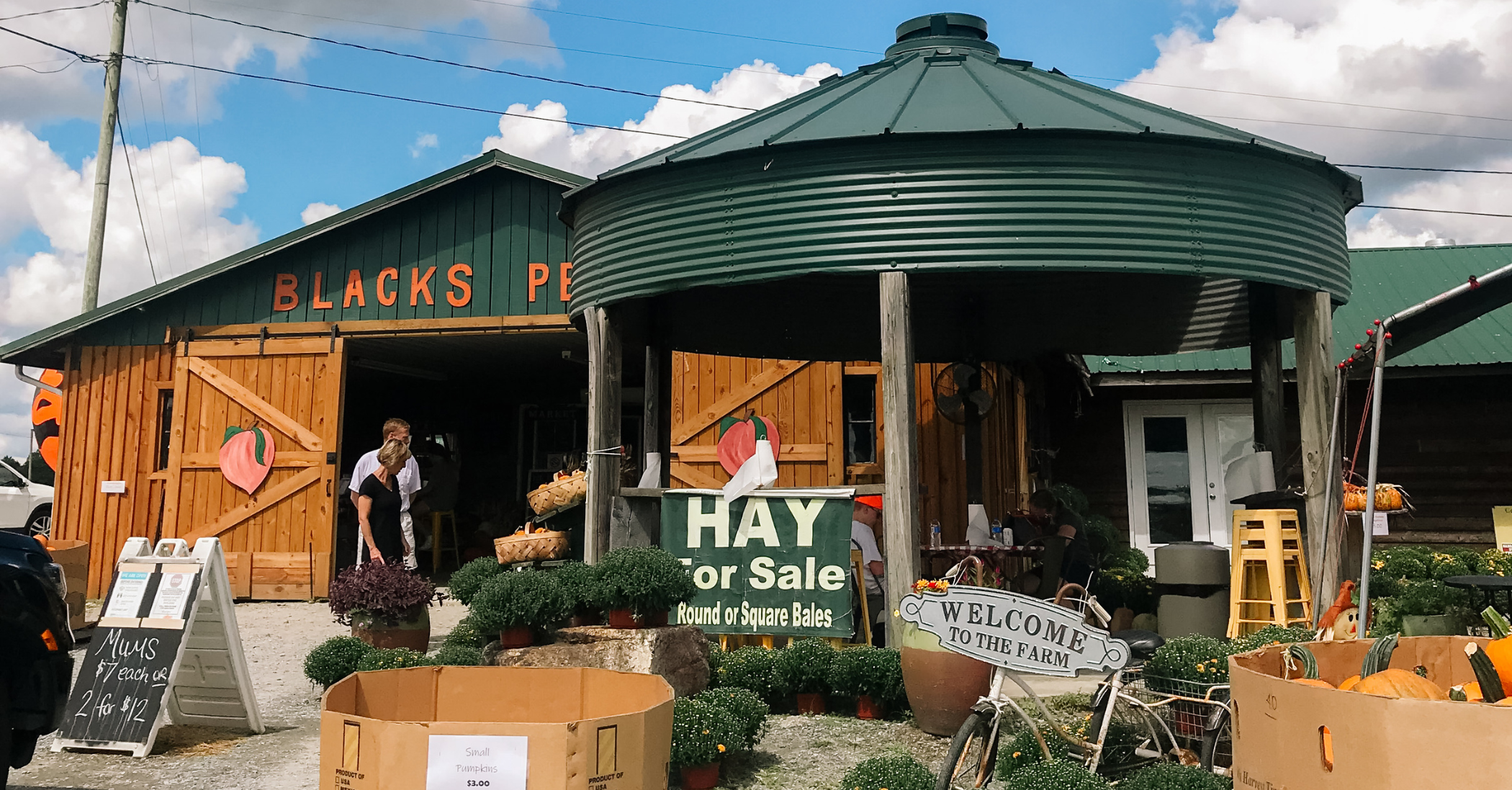
When Arthur Black talks about the history of his family’s farm, more than 300 years can pass in a matter of minutes.
There was cotton. A cotton gin. Peaches. Grapes and scuppernongs. Corn, soybeans and grain sorghum. A country store. A swimming hole and dance hall. Pumpkins and tomatoes. A farm kitchen. Field trips, hayrides and generations of families who have made visiting Black’s Peaches part of their own traditions.
The farm has changed many times since the Black family first began farming this land in 1718.
But as Arthur puts it, the dirt has stayed the same.
Today, Arthur and his daughter, Beth Black White, are continuing that history while figuring out what generations of the Black family before them also had to determine: what does this farm need to become in order to keep farming?
More Than 300 Years on the Same Land
“I’ve been here 76 years, on this one farm,” Arthur told me when I sat down with him and Beth recently. “And the farm’s been in our family since 1718.”
The family's history is intertwined with the history of York County itself.
Arthur's great-great-great uncle, Felix Quinn, was the first sheriff of York County. His grandfather served in the South Carolina legislature and helped bring electricity and improved roads to the area. His father served for 20 years on what would eventually become York County Council, and Arthur served 16 years on the school board.
“There’s been a lot of thought about our community and our neighbors,” Arthur said.
There has also been a lot of change.
In 1923, the boll weevil arrived as cotton was declining. Arthur's grandfather, who operated a cotton gin, planted peaches.
Those peaches would become one of the constants of the next century.
Today, the family believes Black’s Peaches is the oldest continuously operated peach orchard in South Carolina.
But peaches alone aren't the reason the farm is still here.
A History of Trying Something New
Spend enough time talking with Arthur and Beth and a pattern begins to emerge.
The Black family has never stopped experimenting.
“We’ve tried lots of things,” Arthur said.
Some worked. Plenty didn't.
That willingness to adapt is a theme throughout the farm's history.
During the Depression, Arthur's grandparents dammed a creek on the property and created a swimming hole and two-story dance hall. People came to the farm to swim, dance and spend time together.
Long before “agritourism” became a familiar part of the agricultural economy, the Black family was already using experiences to bring people onto the farm.
“Agritourism has been in our heritage for over 100 years now,” Arthur said.
That history continued decades later when Arthur began expanding agritourism on the farm. Then, in 2006, Beth came back to work in the family business full-time.
She hadn't necessarily planned on becoming a farmer.
Beth studied political science and once thought she might become a lawyer. But after growing up playing in cotton wagons and hay bales and working part-time on the farm, her path eventually brought her home.
Arthur asked her to help figure out how they could build the business and keep the farm going.
That's when the family began expanding its agritourism offerings and developing the kitchen that has become an important part of the business today.
“Everything's seasonal and everything goes to pot sometimes,” Beth said. “One thing that stays the same is we're able to keep the kitchen open and keep people coming in.”
For Beth, agritourism has become an important part of the farm's ability to weather the years when Mother Nature doesn't cooperate.
“That has really kept us going, especially with the weather, when we don't have crops,” she said.
Farming Means Paying Attention to What People Want
Adaptation at Black's hasn't only meant adding new experiences.
It has also meant understanding a changing customer.
About 35 years ago, Arthur ordered peach trees and received 500 trees of a white peach variety by mistake.
He planted them.
At first, he couldn't sell them.
Over time, however, Black's developed a market for the fruit. Today, the farm has roughly 1,500 white peach trees, and customers travel from places including Atlanta, Hickory, Conover and Tennessee to pick them.
“You have to pay attention to where your market is,” Arthur said.
The same principle applies to how much customers buy.
Beth remembers when customers routinely came to the farm and purchased half-bushels of produce to can or freeze for later in the year.
Today, customers are more likely to buy smaller quantities for the days immediately ahead.
“People are weekly, not yearly,” she said.
So the farm adapted again.
That ability to respond to changing markets, changing weather and changing consumer habits is part of what has allowed the business to continue for generations.
As Beth succinctly put it:
“The key to farming is staying hopeful.”
Creating a Place People Want to Return To
There is another thread running through the Black family story that is harder to measure on a balance sheet.
It's the role the farm has played as a gathering place.
One of Beth's favorite memories is of her grandmother, who lived in the family's big house and prepared lunch every day.
She didn't necessarily know how many people would show up.
Sometimes there might be five. Sometimes there might be 25.
Family members, farm workers and whoever else happened to be there gathered around the table.
Arthur remembers his mother taking her plate, sitting down and asking everyone the same question:
“What have you heard today?”
For Beth, memories of sitting around that table, shelling beans on the back porch and shucking corn are at the heart of what she hopes people can still experience when they visit Black's today.
“We hope they feel a little sense of nostalgia and at home, because we put our heart and soul into it,” she said. “We just want to make people want to come back and smile and feel like they're part of our family.”
That spirit can now be found in the farm's kitchen, field trips, fall activities, pick-your-own experiences and other events that continue bringing people onto the property.
It was also evident at Black's first Farm to Table Dinner, where local farms, chefs and community members gathered for a meal built around food grown close to home.
Before dinner, Arthur welcomed everyone by explaining that many people and farms had collaborated to put the meal on the table.
“It’s just part of what agriculture is,” he told the crowd, “to put everything together and bring it to you folks.”
The response to the dinner was strong enough that the family is already discussing another.
In some ways, it feels like a new chapter for Black's.
In others, gathering people around a table is something this family has been doing for generations.
Keeping a Farm a Farm
York County looks dramatically different today than it did when Arthur was a child.
The road outside the farm that was once traveled by horse and buggy is now a five-lane highway. New residents continue moving into the county. Land that was once rural is increasingly surrounded by development.
Through all of that growth, the Black family has continued farming.
And now they are making plans to ensure this particular piece of York County remains farmland beyond their own generation.
The family is preparing to place the farm into a conservation easement.
“It’ll be a farm forever,” Arthur said. “Whether it’s us or whoever, it won’t be developed into any houses or businesses or anything like that.”
After more than three centuries of adaptation, perhaps that's the most fitting next chapter.
The crops may change.
Customers will change.
The ways people experience agriculture will continue to change.
The Black family has shown that preserving a farm doesn't require keeping it frozen in time. Sometimes preserving it requires being willing to change almost everything else.
The dirt is the constant.